
Published by Vahab Hasiri | Consilium Dynamics Advisors
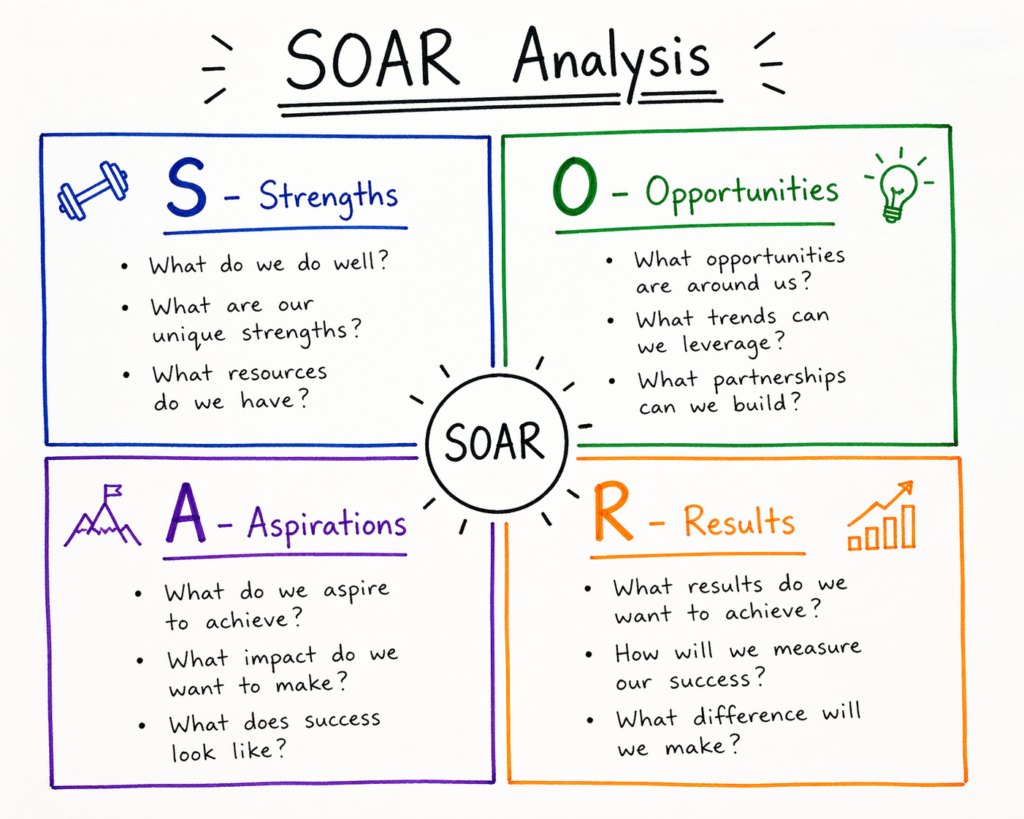
If you’ve ever walked out of a strategy session feeling more drained than inspired, you’re not alone. Most leaders are familiar with SWOT Analysis, and it’s a classic for a reason but if we’re being honest, the “weaknesses” and “threats” sections have a tendency to turn strategic planning into a fear-based, problem-obsessed conversation that leaves your team flat rather than fired up.
There’s a better lens. It’s called SOAR Analysis, and it’s built for leaders who want to move from fixing what’s broken to building on what actually works.
What Is SOAR Analysis?
SOAR stands for Strengths, Opportunities, Aspirations, and Results.
It’s a strengths-based strategic planning framework designed to help leadership teams get clear on what they do best, identify real possibilities in the market, define a vision worth chasing, and measure meaningful progress.
Unlike SWOT, SOAR doesn’t ask you to dwell on what might go wrong. It asks you to build from what’s already right, and direct that energy toward the future you want to create.
A study published in the Journal of Business Strategy found that strengths-based planning approaches like SOAR can significantly boost employee engagement and performance. The reason is straightforward: people are more motivated when their work is tied to growth and possibility, not just risk avoidance.
SOAR vs. SWOT: Why the Shift Matters
Both frameworks serve a purpose. SWOT is useful for defensive planning and risk identification. SOAR is designed for growth-oriented, forward-looking strategy sessions where you need your team bought in and moving together.
Research from Gallup’s State of the Global Workplace report consistently shows that focusing on what people do well improves both performance and job satisfaction. When your planning process amplifies strengths rather than catalogues deficiencies, your team develops a sense of ownership over the vision, and people execute plans they helped shape.
The Four Components of SOAR Analysis
1. Strengths: What Do You Already Do Exceptionally Well?
This is about identifying the capabilities, assets, and advantages your business already has. Strengths might include a loyal customer base, a high-performing team, proprietary processes, or a trusted brand reputation.
Key questions to ask:
- What do we consistently do better than our competitors?
- What do our customers praise us for most?
- What resources or capabilities give us a real edge?
2. Opportunities: Where Is Your Market Opening Up?
Opportunities require you to scan the external environment for trends, gaps, and shifts that align with your existing strengths. This is where strategy becomes proactive rather than reactive.
Key questions to ask:
- What external trends or market changes can we capitalize on?
- What customer problems are still going unmet?
- Where can our strengths help us enter a new market or segment?
3. Aspirations: What Kind of Company Do You Want to Build?
Aspirations go beyond traditional goal-setting. This is where you define your big-picture vision — one that’s ambitious enough to inspire and specific enough to guide real decisions. Without a compelling aspiration, strategy becomes maintenance.
Key questions to ask:
- What does this company look like in three to five years?
- What legacy do we want to build for our customers and team?
- How do we want to be known in our industry?
4. Results: How Will You Know You’re Winning?
Results translate aspirations into measurable targets. If you can’t measure it, you can’t manage it. This pillar ensures your SOAR plan doesn’t stay on a whiteboard, it turns into accountable execution.
Key questions to ask:
- What KPIs actually reflect success for us?
- How will we know if we’re on track at 30, 60, and 90 days?
- Who owns which metric?
How to Run a SOAR Workshop: A Step-by-Step Guide
The power of SOAR is that it’s collaborative by design. Here’s a practical approach to running your first session:
Step 1 — Gather the Right People Include a mix of leadership, frontline team members, and if relevant, key partners or loyal customers. Diverse perspectives sharpen the output.
Step 2 — Bring Real Data Don’t rely solely on gut feel. Use customer feedback, sales trends, market research, and internal performance data to ground the conversation in reality.
Step 3 — Facilitate Through the Four Pillars Work through Strengths and Opportunities first to build energy and context, then move into Aspirations and Results. The sequence matters, energy before accountability.
Step 4 — Turn Insights Into Action Convert every key insight into a specific action item with an owner, a timeline, and a measurable milestone. Keep the output lean and executable.
Step 5 — Review Quarterly A SOAR plan isn’t a one-time exercise. Schedule quarterly check-ins to assess your Results, revisit your Aspirations, and adjust based on what the market is telling you.
A Real-World Example of SOAR in Action
Consider Patagonia:
Their Strengths: a trusted brand and a deeply loyal community of environmentally conscious consumers.
Their Opportunities: growing demand for sustainable products and supply chain transparency.
Their Aspiration: to become the world’s most responsible company.
Their Results: measurable targets around carbon footprint reduction and supply chain ethics.
They didn’t succeed by fixing what was broken. They doubled down on their strengths, pointed them toward a clear aspiration, and built a measurable roadmap around it.
Is SOAR Analysis Right for Your Business?
SOAR works especially well for:
- Founder-led businesses scaling past a growth inflection point and needing a unified strategic direction
- Leadership teams that are high-performing but misaligned on vision
- Annual or quarterly strategy sessions where the goal is execution momentum, not just problem identification
- Organizations where engagement and ownership matter as much as the plan itself
If your team leaves strategy sessions feeling defensive rather than energized, SOAR is worth trying.
Final Thought
The next time you sit down for a strategic planning session, consider what framework you’re actually handing your team. SWOT asks, what could go wrong? SOAR asks, what could we become?
That’s a different conversation, and it produces a different kind of team.
If you want help designing a strengths-based strategic plan your whole team can execute against, book a Strategy Session with Consilium Dynamics Advisors. We work with founder-CEOs building 7 and 8 figure businesses, and we specialize in turning strategic clarity into structural growth.